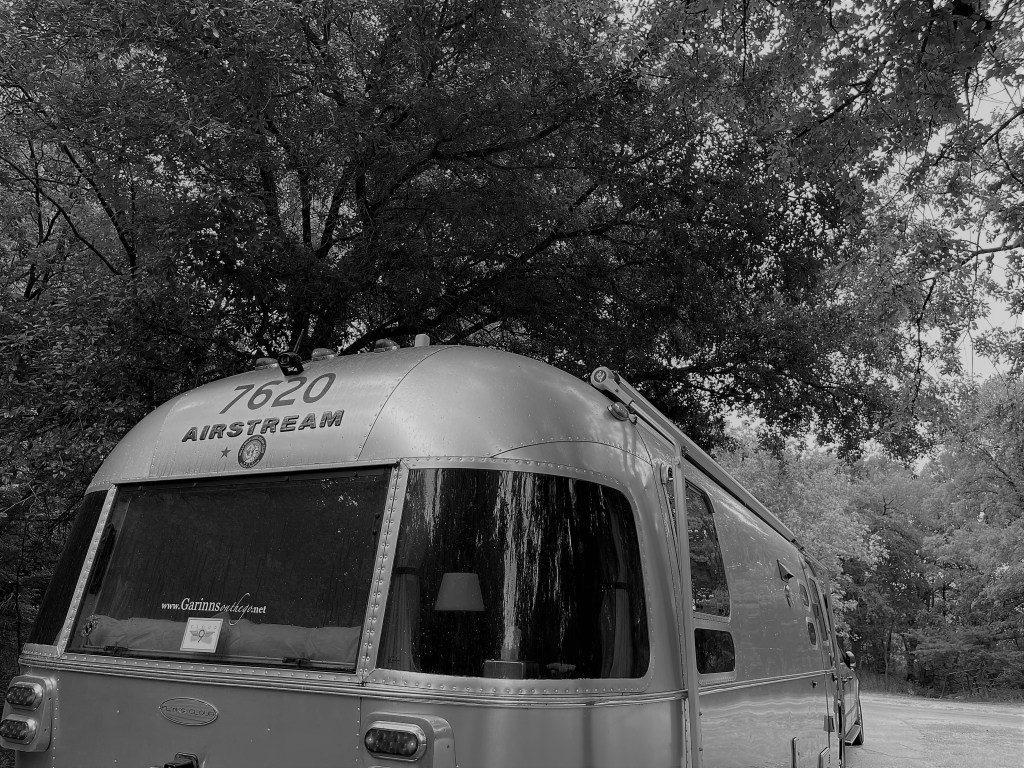
This weekend marked the 10th anniversary of living the “RV lifestyle.” For the better part of a decade now, we’ve packed up and headed out for a weekend away from it all.
Jon’s first camping-related blog post was titled “Simple Pleasures.” In it, he described a camping experience he had when he was serving as a pastoral intern in his hometown.
“A nice older couple, upon hearing that I had been a Boy Scout, invited me to join them for a little campout at Carlyle Lake,” he wrote. “We set the date, and as the time approached I began to prepare. Like a dutiful Scout, I packed my sleeping bag, mess kit and backpack, complete with a survival kit, hiking boots and waterproof gear. On the appointed day, the couple pulled up to the rectory in an enormous Winnebago. It was a behemoth! And it had every imaginable amenity: a washer and dryer, shower and tub, microwave and convection ovens, kitchen island, king-sized bed in the master bedroom, giant side-by-side refrigerator/freezer. I could go on, but you get the idea. I scampered aboard, embarrassed that I had overpacked, and settled into a plush leather recliner for the 35-minute drive to the campsite. There, we hooked up, plugged in, turned on, and settled down. My hosts extended an awning from the side of the rig, dropped mosquito netting all ’round, set up some lawn chairs on the concrete pad, sat down and said, ‘Now THIS is living.'”
Jon was a bit brash in those days, which accounts for his response: “Living? All you’ve actually done is move your living room from your house to the lake!”
Clearly, he had yet to fully appreciate the “RV lifestyle.”
It would be 25 years before we bought our first camper, a 19-foot Sportsmen Classic. It wasn’t a “Winnebehmoth,” but it was a home away from home. We purchased our first Airstream just 10 months later, a 23-foot Sport. Then, 10 months after that, we moved into Cloud 9.
Yet even as we embarked on that first weekender 10 years ago, it occurred to us that the “RV lifestyle” is first and foremost about recreation. Nearly every weekend since that time, we’ve left behind our workaday worries and residential responsibilities to spend long, luxurious hours cooking wonderful meals, taking long walks under starlit skies, and listening to the sounds of our natural surroundings.
Not long after we started our weekenders, one of Jon’s colleagues asked about our travels and he told her about a typical weekend. She said it didn’t sound much different than what we did on any other weekend when were at home. But it’s not like a typical weekend at home. We don’t do chores. We don’t do yard work. We don’t do laundry. We don’t run errands. We don’t fret over finances. And we don’t fall asleep, exhausted, in front of the TV.
Sure, we’re not “roughing it” in a tent and a sleeping bag. We’ve got air-conditioning, refrigeration, a flush toilet and a shower, a microwave oven and, most important, the Internet! But there’s something nice about waking and sleeping with the rising and setting sun; seeing rabbits and roadrunners right outside our window; listening to waves lapping at the shoreline; cooking on a open fire and savoring every smoky morsel; and taking in a wide-angle view of the big Texas sky—all with our loving companion animals.
Despite its small size (or perhaps because of it), our tiny house represents to us a big idea: Minimalism. We are so often overwhelmed by the complexity of modern life, the idea of getting away from it all, in a little, self-contained house, is so alluring that it almost seems novel. Yet people have longed for just such minimal existence for centuries.
The Roman architect Vitruvius asserted that every structure must be solid, useful and beautiful. Accordingly, architecture should imitate nature. A bird’s nest and a beehive, although simple structures, are solid, useful and beautiful, particularly to the birds and the bees that occupy them. Thus, even a simple shelter in a forest can be virtuous.
Our little structure shouldn’t be thought of as an emergency accommodation or a temporary shelter, but a voluntary place of retreat—one that minimizes our ecological footprint and reduces our living environment to only the most essential elements.
After 10 years of living large in this small space nearly every weekend, we can say, with some confidence, THIS is living!


 Garinns on the Go