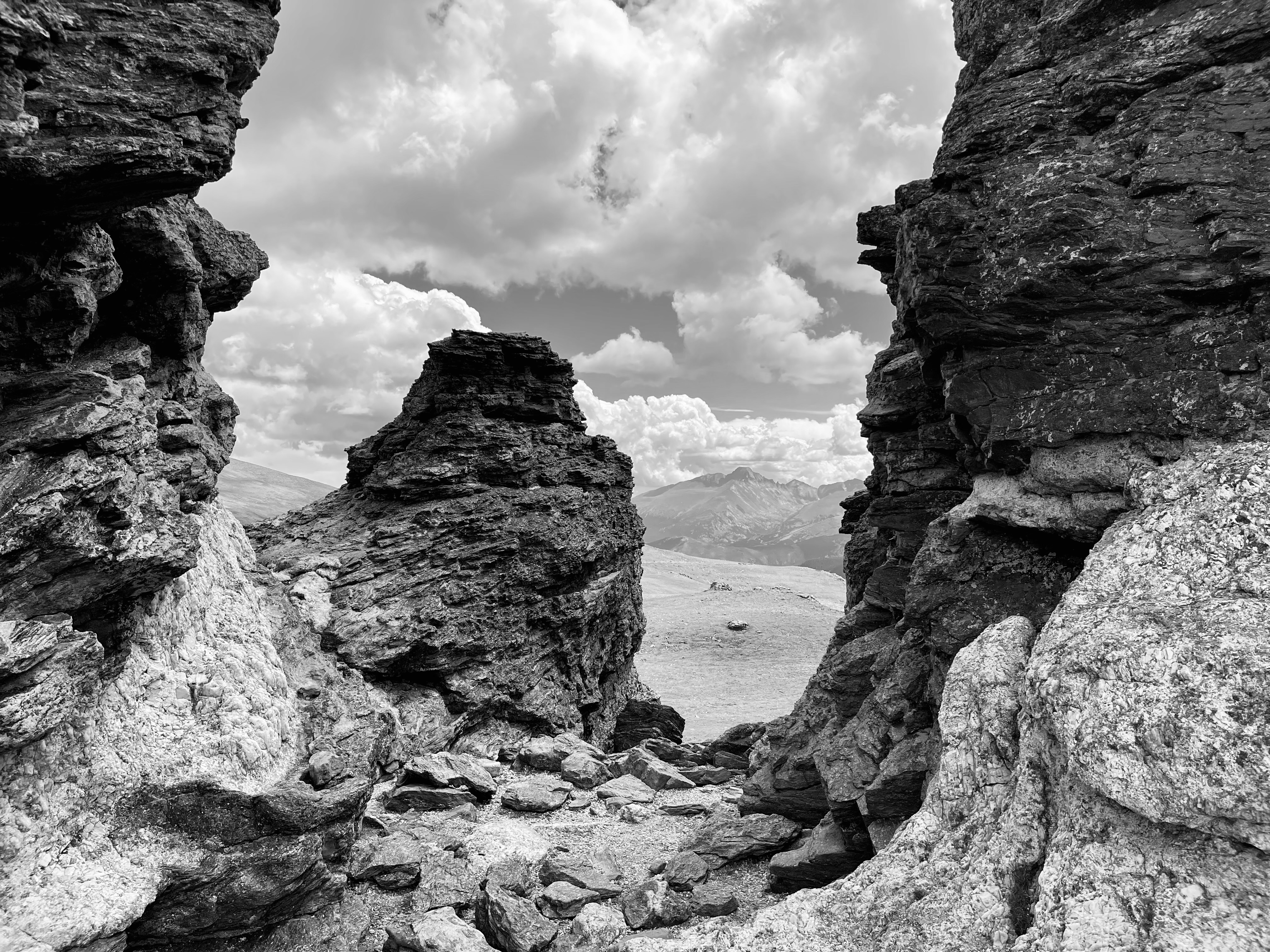
We returned to Rocky Mountain National Park, a promise we made to ourselves when we first visited five years ago. Then we spent five days exploring the park, from end to end and all points in between. This time, we decided to include a hike on the Tundra Communities Trail, located at Rock Cut near the top of Trail Ridge Road.
Although it has a trail difficulty rating of 1.45 (easy), we found the 175-foot ascent demanding, likely because we were not acclimated to the altitude. With roughly 35 percent less oxygen than at sea level, our breath was immediately taken away as we began climbing the fairly steep grade at 12,110 feet. Fortunately, the Park Service did a great job of placing interpretive signs along the trail, providing us an excuse to stop periodically, read the information, and catch our breath.
Much of the alpine tundra is covered with dense turfs of sedges and grasses, as well as an array of truly stunning wildflowers. Few animals live at these elevations so we only saw a single pika and a couple birds.
At just over a half-mile, and an elevation of 12,319 feet, we reached the end of the trail at the Roger Toll Memorial. It consists of a plaque on the rocks dedicated to the former superintendent of Rocky Mountain National Park (from 1921 to 1929). Toll was a civil engineer, naturalist, and mountaineer, “whose love of the high country was manifested by helping to make it more accessible,” the memorial plaque declares.
While preparing for our descent, we enjoyed the outstanding panoramic views of Longs Peak, Fall River Pass Road, and the four major mountains of the Mummy range.
We ended our excursion with a quick visit to the Alpine Visitors Center, about four harrowing miles away. The hairpin turns and steep drop-offs (many without guardrails) made for an intense driving experience. We managed to see a single elk at a great distance, but at least we can claim to have had a sighting.
A few lessons we learned along the way are worth sharing:
- Toddlers who are just learning to walk should not be expected to learn on a steep alpine mountain trail.
- The only bighorn sheep you’re likely to see is on the merchandise in the gift shop.
- Ultraviolet radiation levels are twice as high at alpine altitudes than at sea level, and the cooling effect of high-altitude winds can mask the sensation of burning and lead people to underestimate their sun exposure–so wear sunscreen, people!


 Garinns on the Go