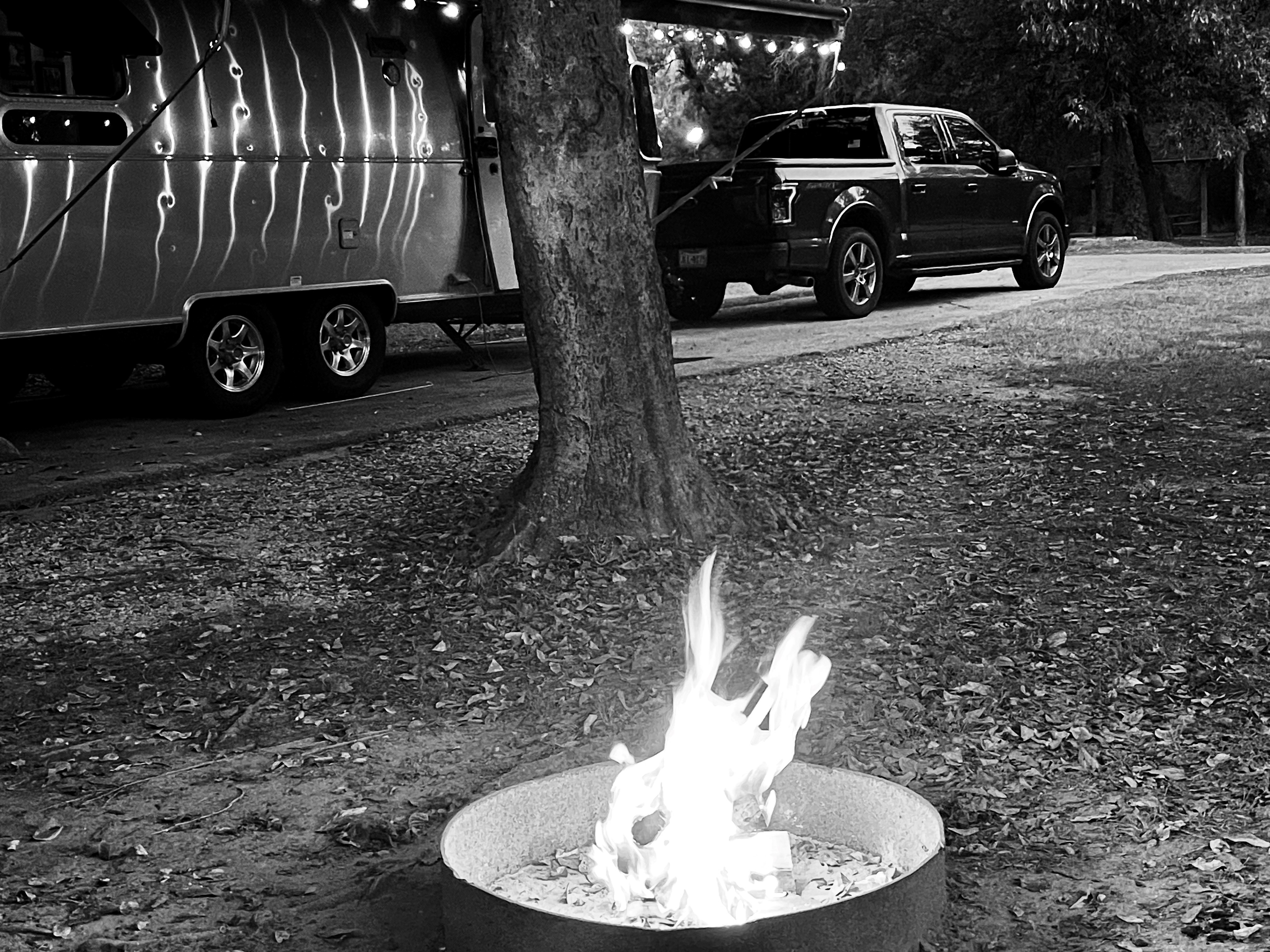
After seven weeks without camping, we made our way to Loyd Park for a magnificent fall weekender. The weather was ideal, with warm temperatures, low humidity, and clear skies. We spent much time outdoors, walking around the park and relaxing under the pavilion, enjoying cookouts and campfires. We’ve missed the regular cadence that has been disrupted by monthly trips to visit Jon’s mom. We don’t regret a single moment that we’ve spent with her. Lately, we’ve become her “roommates,” as we’ve stayed in her apartment rather than at a hotel or in the Airstream. The arrangement, although sometimes awkward, is both economical and practical. We can get her the first cup of freshly brewed coffee in the morning and ensure she gets to bed safely and comfortably at night.
We’ve spent uncounted hours traveling back and forth between Dallas and St. Louis discussing her situation. Her world has become so small that even the slightest inconvenience gets blown out of proportion. She spends each day traversing the 10 feet between her desk chair and the bathroom, which, in her condition, leaves her struggling to breathe. Because she has late-stage COPD, chronic asthma, and acute emphysema, she needs time to recover from even the slightest exertion.
Arranged around her, in teetering piles, is a mix of junk mail and essential notifications. Somewhere in a pile was the notification that her Medicare Part D insurance supplement had lapsed. She didn’t need the supplemental coverage because, as a Medicaid recipient, the state would have funded the gap. But because she had been paying for the gap coverage out of pocket (less than $10 a month), her Medicaid didn’t kick in. We spent the better part of two weeks trying to negotiate a refill of an essential prescription.
When we visited her over Labor Day weekend, we noticed that her air-conditioner had been leaking onto the carpet beneath the unit, saturating it with water. The leak was so pernicious that it defied all efforts to catch it in a bowl and stanch it with spare towels. She would have never known, given the fact that the flooded area was not in her path from the desk to the bathroom. Only when the maintenance man arrived (during his day off) to clear the drain tube was the leak finally halted. The unit was replaced entirely during our most recent stay. Still, in her small world, the only thing that mattered was the bothersome sound of the new unit’s compressor.
She has had a recent history of rebounding from catastrophe. Since moving to Cambridge House, she has been hospitalized three times, for COVID and for pneumonia—both respiratory illnesses that would have claimed the life of anyone whose lungs are as compromised as hers. Miraculously, none of these incidents seemed to defeat her. She still retains her sharp mind and wicked sense of humor. Even as her health has declined, she adheres to the same routine she has kept for years: up early, with the first fingers of light through the bedroom window. Coffee and toast, usually with grape jelly. Then on to the computer to scroll through her Facebook feed. This is her connection between her small world in apartment 113 and the larger world beyond.
During our recent visit, sitting alongside her, we realized that her resiliency would no longer be sufficient to sustain her. A PET scan revealed that her lung nodules were problematic. Only a biopsy would determine whether they were cancerous, but the risk of a biopsy was greater than the benefit. She decided to take a “watchful waiting” approach and get another scan in a few months.
Every morning, when he calls his mom, Jon asks her how she slept through the night. More often than not, she says, “not well.” It’s not the night so much that bothers her as it is the morning hour, the daunting re-entry into the day—the necessity to wake up and start the grueling task of getting through the day all over again. Still, with some encouragement, she presses forward.
At 82, she is slight and hunched but formidable—the unruly facial hairs and crown of hair that looks like steel wool notwithstanding. Old age seems to suit her. As she’s gotten older, in addition to becoming more benevolent and benign, she’s gotten more beautiful in a way. Her gaze is softer, more tender. You would miss this subtle transformation if your entire relationship consisted of phone calls. You can’t phone in a relationship. It requires commitment, an investment of time, sometimes sacrifice.
Clearly, at this stage in her life, death is a constant threat. But she is clear-eyed about the dangers lurking behind every CNA or dietary aide or housekeeper or healthcare provider who enters her room. Despite her many challenges, she still approaches life as she always has: as something to be dealt with as directly as she can manage. Her hard life has brought her to a moment of clarity about what really matters: She is not afraid of dying…only of dying alone.


 Garinns on the Go