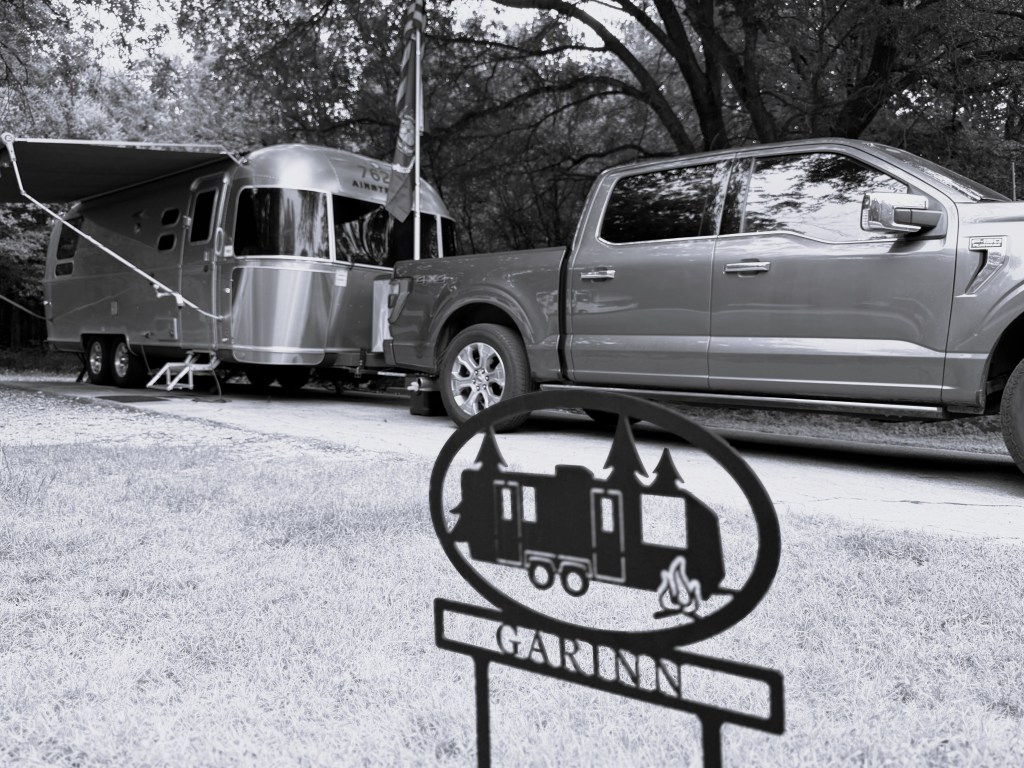
We met some fellow Airstreamers this weekend who had traveled to Texas from California. As we typically do when meeting people for the first time, we started sharing stories about ourselves and our adventures.
The stories we tell about ourselves come from our own experiences, but over time some have been embellished for comedic effect, others have been distilled to their essential lesson. For reasons we do not know, our imaginations have taken a few seeds of truth and grown them into trees—hopefully substantial enough for new acquaintances to find a place of respite in or beneath their branches.
All the stories we tell about ourselves have been told, either whole or in part, before we committed them to writing. They weren’t written and then read, a standard way for stories to be received by listeners. They had an oral origin that we’ve gradually refined and finally stabilized in this blog. The written form is the same story as the spoken version, but it’s not simply a matter of typing out what our voices say. As we’ve given them written form, we’ve made subtle changes in phrasing and sometimes significant developments. This blog has become a reflection of our spoken-written history. The recipients of the stories we tell about ourselves, either listeners or readers or both, give us a sense of purpose. When we tell stories about ourselves we can feel a certain connection between ourselves and our listeners. Both listener and storyteller are attentive to—and invested in—what is unfolding. The story becomes a commonly shared world, with an outcome that is not always entirely predictable or controllable.
The stories we tell about ourselves share a common ambition: a deep desire for meaning. A determination to somehow elevate our routine with adventure, with wonder. If we are alert to meaning, our tired old stories can bring comfort and challenge in unexpected ways.
The stories we tell about ourselves are ultimately an expression of our longing for connection, constancy, comfort.
On Saturday, we had an opportunity to delve deeply into the story of Edward R. Murrow and his team of journalists as they confronted the anti-Communist hysteria led by Sen. Joseph McCarthy in the early 1950s. We began by watching the live telecast of the Broadway drama, “Good Night, and Good Luck.” Both the stage play and the earlier film version explore themes of journalistic integrity, freedom of the press, and the dangers of government overreach.
The prevailing mood throughout the Red Scare, as it came to be know, was intense fear. McCarthy’s aggressive investigations and hearings were intended to root out alleged Communists in government, entertainment, academia, journalism, business, sports, and other sectors. Yet his actions often lacked solid evidence and relied on intimidation and public shaming. Murrow used his “See It Now” news program to turn public opinion against McCarthy by exposing his tactics, and, in so doing, established the role of journalists as watchdogs for democracy.
The story is based on real-life events, including the case of Milo Radulovich, an Air Force Reserve lieutenant who was discharged because his father and sister were allegedly associated with Communist organizations—despite no evidence that Radulovich himself held any such beliefs. By spotlighting Radulovich’s case, Murrow humanized the cost of McCarthyism, showing how innocent people were being punished based on guilt by association.
The parallels with today’s media landscape are clear: Press freedom is increasingly under threat by fear-driven politics, journalists are reluctant to take a bold stand against political intimidation, and the rise of disinformation and declining public trust have further eroded journalism’s role as a check on power.
In sharing stories—whether around a campfire or through the lens of history—we affirm our shared humanity. The stories we tell, shaped by memory and meaning, connect us not only to each other but to the broader currents of truth and justice that define our times. Just as Murrow’s unwavering voice challenged fear with fact, our own narratives, however humble, carry the power to illuminate, to comfort, and to inspire. In a world where truth is often contested, the stories we tell—and how we tell them—matter more than ever.


 Garinns on the Go