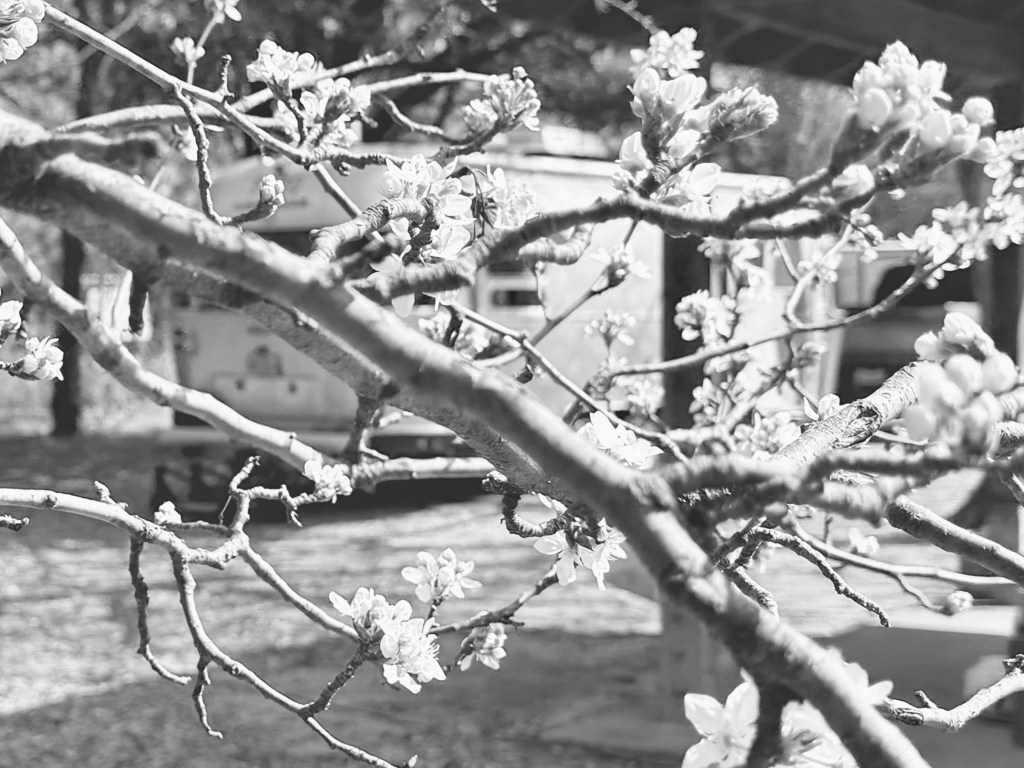
We arrived on Friday afternoon ready for a spring‑like escape, with temperatures in the low 80s, clear skies, warm breezes, and the first blossoms sprinkling the forest. It felt like we were on the cusp of renewal.
Then, on Saturday morning, everything changed.
Jon awoke to the news alerts: President Trump announced that a joint U.S.-Israeli operation had targeted Iran’s supreme leader, Ayatollah Ali Khamenei. Iranian state media later confirmed his death and declared a period of mourning. Through the day and into the night, reports described continued strikes and retaliatory fire across the region, underscoring how quickly a single event can widen into something more dangerous.
Khamenei’s death closes a long chapter in Iran’s history. Whatever anyone thought of his rule, his death creates a void that no one can predict with confidence. News coverage and its accompanying commentary emphasized both the leadership vacuum and the risks of instability as power brokers jostle for control. By Sunday, media outlets reported that clerics had moved to form an interim leadership council in an attempt to provide continuity.
It’s not only geopolitics; it’s human life. Each headline implies families bracing for what comes next, people refreshing feeds for proof that loved ones are safe, and a country recalculating its next breath.
As the stories from Tehran unfolded, our thoughts drifted back to Venezuela earlier this winter. When Nicolás Maduro was forced from power, some hoped it would open a path toward democratic renewal. Instead, his inner circle stayed largely in place while the opposition, once broad and organized, struggled to regain footing. Removing the strongman didn’t unwind the machinery around him; it exposed how inadequate the U.S. strategy was to the task.
We tried to distract ourselves, if only briefly, by focusing on the coming spring. Morning light sifted through the trees; singing birds traded notes; blossoms kept their quiet schedules with little regard to who has power; wind moved on no one’s command. The task, it seems, isn’t to choose between peace and conflict, but to pursue clarity inside both.
There’s a long American shadow in Iran’s story. Saturday’s strike added another layer of uncertainty, not only for Iran but for a region where miscalculation travels fast. Reports warned of missiles, drones, and proxy attacks, along with the risk that a domestic scramble for authority could spill outward.
We don’t know what tomorrow will bring. But we keep coming back to a simple practice we learned on the trail: leave the campsite better than you found it. In moments that feel outsized, the only controllable radius might be the few feet around our lives: how we speak, what we amplify, whom we show up for.
So we did small things. We called Cliff s sister, Teresa, and our old pal, Bud. We read The New York Times, the Wall Street Journal, and The Washington Post. We watched CNN, PBS, MS NOW, CBS, NBC. Eventually, we stepped away from doom‑scrolling long enough to listen for birdsong. We re beginning to identify birds by their songs and their calls, so we have a natural distraction if we choose it. None of this changed the geopolitical realities. But it changes us.
If there’s a lesson to be learned, it’s this: If we live with intention, keep hope alive, and understand that action can be distraction, eventually, spring will come.


 Garinns on the Go