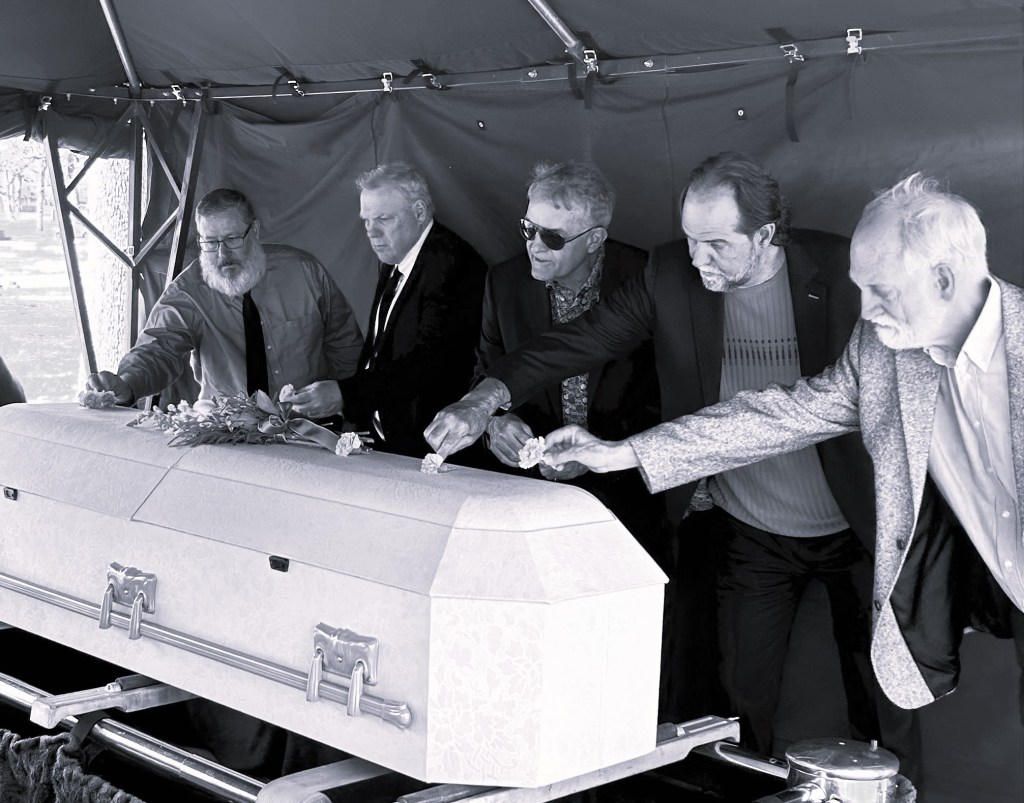
We headed to Loyd Park for a beautiful spring-like weekend, but our minds were focused on the main event: the funeral for Cliff’s Aunt Doris. She died on February 12 at the age of 100 after having lived a good life, by all accounts. There was sadness, but also a sense of relief. She had lived the last years of her life in the fog of dementia, no longer able to recall the memories that gave her life meaning. Her gathered loved ones recalled the many ways she touched their lives, mostly simple acts of kindness and personality quirks. Talk of her fried chicken prompted Cliff to ask for the recipe, which had been passed down to Doris from her mother, Cliff’s grandmother. The image of a young Doris singing in the cotton fields around San Gabriel, Texas, or of a new wife and mother making sure her boys were well fed, was juxtaposed by the doting grandmother she became, a “kidnapper” who would often steal away the little ones for ice cream treats.
Aunt Doris’s burial prompted reflection and conversation that lasted well into the night about aging and memory, preservation and loss. Knowing that we store our memories in fragile brains that can easily be damaged or destroyed can, in turn, prompt a bit of instability in our sense of self. After all, who are we without our memories? There’s something disquieting about knowing that a neurological condition or cognitive decline could wipe out these precious remnants of meaning as easily as tapping the delete button.
Somewhere among all the stuff we’ve accumulated through the years are boxes of video tapes with recordings of our family and friends, many of whom have died. We’ve been afraid to have them converted to a format that would enable us to watch them again, not really because of the emotion they might bring up but because we’re afraid that the tapes, which have been stored in the attic for more than two decades, might have deteriorated, leaving us without these precious memories. We’d rather leave them unplayed than discover we’ve lost something because of our negligence.
A few weeks ago, Jon shared with a colleague that among his favorite poems is Percy Bysshe Shelley’s famous sonnet, “Ozymandias,” first published in 1818. It’s a poem he analyzed in high school, the one in which a traveler happens across a “colossal wreck” of a statue of the Egyptian ruler Ramses II in the desert. The statue is inscribed with the boastful claim that one ought to “Look on my Works, ye Mighty, and despair!”
“Nothing beside remains,” the poem continues, ironically concluding that “round the decay” the “lone and level sands stretch far away.” Shelley’s message is clear: Our greatest works and memories seem foolish when subjected to the ravages of time. Most people have been forgotten, most artworks destroyed, most books now unread. Still, we try to preserve what we can.
As we gathered to bid farewell to Aunt Doris, it occurred to us that our effort to remember is at the heart of what it means to be human. The act of trying to preserve and celebrate our memories is far more meaningful than whether that effort succeeds.
In an age where everything is easily disposable, when most of us will be forgotten after a generation or two, what matters most is what we do here and now.


