This weekend, as the Blue Moon shone brightly overhead, we spent time around the campfire, settling into a reflection on our nation’s 250th birthday.
Two hundred and fifty years.
That number gets thrown around a lot, like it’s supposed to mean something all by itself. And it does, in a way. It means endurance. It means we made it this far without the whole thing collapsing in on itself. But sitting around the campfire, we started to wonder what exactly we carried with us across those years and what we left behind along the way.
Because if you pause long enough to really look at it, really sit with it the way you do when the conversation gets quiet and a little more honest than usual, the picture gets more complicated.
Undeniably, we’ve built something powerful and meaningful; inspirational and aspirational. But we’ve also built a country where millions of people still worry about their next meal, or a doctor’s visit they can’t afford, or a rent check that’s climbing faster than their paychecks. We’ve built roads and systems and institutions, but some of them are clearly cracking under pressure.
The language we started with was so clear: Life, liberty, happiness. A government that answers to its people. Big ideas, yes. Beautiful ones, absolutely. The kind you can talk about around a campfire and everybody nods along in agreement.
And then you look at what we celebrate; at who we profess to be.
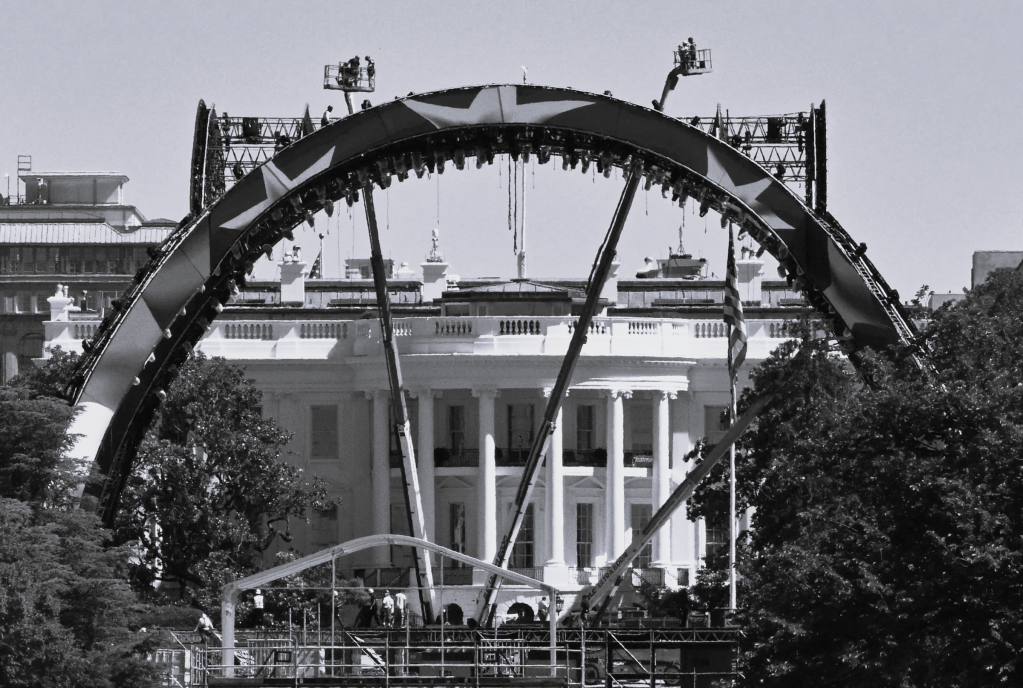
A wrestling arena on the White House lawn? It’s not that wrestling is bad or spectacle is wrong, but it elevates entertainment over service, yet again. We keep choosing what feels good in the moment over what does good in the long run. We opt for show over substance; the noise over the necessary.
You see it everywhere, if you pay attention. What we pay people to do. What we watch. What we reward. Who we listen to. You can see it in the way we fill a stadium for a game but struggle to fill a classroom with resources. Or how quickly an uninformed opinion travels compared to something more considered, more nuanced, more diplomatic.
And it shows up most clearly in our leadership.
While the country turns 250, the person holding the highest office in it seems caught up in things that feel insignificant by comparison. A gilded ballroom. A blue reflection pool. A massive triumphal arch. Just this weekend, he picked a fight with a federal judge who did exactly what judges are supposed to do, which is read the law and apply it, and all because of his need to have his name on things that already belong to history.
That moment with the Kennedy Center: The law says what it says. It’s been agreed on for decades. A judge read it, upheld it, did his job. And instead of that being the end of it, the president turned into something personal. Something louder. Something meant to pressure instead of persuade.
It was a different kind of heat than we experienced around the campfire. It wasn’t warm. It was just incendiary.
And then there’s the way he talks about himself. The comparisons to Washington and Lincoln. The AI-generated images, the empty claims, the constant reaching for a place among the greatest of all time. It feels less like confidence and more like a man trying to convince himself of something that hasn’t quite landed.
You don’t need to tell people you belong next to the nation’s greatest presidents if the work you’re doing is already writing that story. History has a way of deciding those things without being asked.
Even his medical report, the way it was released, the way it was framed, and then everything that came right after it. It’s hard not to notice the gap between what was reported and what we’ve seen with our own eyes. We’re not idiots. We’ve watched him fall asleep at meetings, over and over again. We’ve seen him use bad makeup to cover bruises by what his doctors attributed to handshaking and aspirin. We’ve seen him pack on 14 pounds over the last year and yet, according to his doctors, he supposedly has a heart of someone 14 years younger. We’re not sure whether we should be incredulous or insulted.
But here’s the part that matters more than any one person: None of this happened in a vacuum. The nation’s leadership is a reflection on its people. The spectacle will only continue if we keep watching. His priorities will only hold if we keep accepting them.
That’s the harder conversation. The one that gets a little quieter around the campfire.
Because it’s easier to point at a stage, or a post, or a moment in time, and say, “That’s not who we are.” But if we’re being honest, it is at least part of who we’ve become. Not all of us. Not always. But enough times that it adds up.
Enough times that 250 years later, we can’t just celebrate without asking some deeper questions.
What would it look like if we choose differently, consistently, not just when it’s easy or popular?
What would it look like if we invest in things that don’t make headlines but make lives better?
What would it look like if we measure success not by how it looks on a screen, but by how it felt in a home, a classroom, a hospital?
Those aren’t dramatic questions. They’re not accompanied by fireworks. They’re more like a campfire. They take time. They need tending. They ask you to stay focused.
And maybe that’s where the hope is.
The Declaration wasn’t a description of the country we had. It was a statement about the country we were trying to become. That means the story wasn’t finished in 1776. And it’s still not finished in 2026. It’s shaped anew by each generation.
The judge who just does his job. The teacher who keeps showing up. The person who looks past the spectacle and asks what actually matters. Those don’t make for big celebrations, but they’re the things that endure because they are the things that matter.
So yeah, 250 years is a big deal. But it’s the not end of the story.
As we sat by the campfire, the real question wasn’t what we were celebrating, but what we’re going to choose next.


