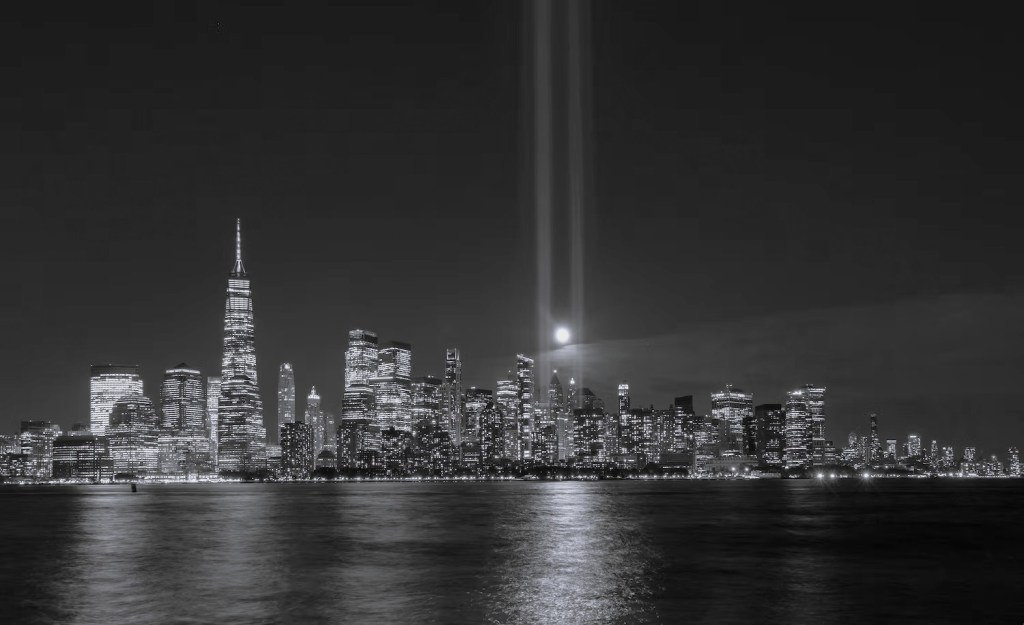
Six months after the terrorist attacks on September 11, 2001, psychologist Eugene Kennedy reflected on something unprecedented. For perhaps the first time in history, we knew what thousands of people thought and said when they knew they were about to die. Through telephone calls, voicemails, messages, and conversations captured in the final moments of their lives, the voices of 9/11 were preserved.
In recalling the messages, Kennedy conjured Black Elk, the Oglala holy man, who described a vision of a vast lodge, as large as the world itself. The people gathered in the lodge spoke to him, across the generations, the distances, and the barriers.
Like the people gathered in that lodge, the people of 9/11 speak to us.
Twenty-five years ago, Kennedy asked, “What do people do when they know they are going to die?”
They tell somebody how much they love them.
The voices from the lodge became a chorus. “There is smoke everywhere. I am trapped. I love you.” Another pleaded, “If you tell me that you love me, I’ll come home.” A young fiancé called only “to tell me that he loved me.” A husband sent one final coded message to his wife: “3-1-8-1-4,” meaning “I love you, forever.” First responders refused to leave because “there are others still here.” On Flight 93, Mark Bingham called his mother to tell her that he loved her. Todd Beamer reached an operator to make sure his wife would hear the same message before he and the others took action.
Different voices. Different lives. Different faiths. Different circumstances. Yet they all spoke the same language. They spoke of love. Faced with death, they thought of life.
As the years have passed, we’ve found ourselves less interested in the tragedy itself and more interested in what those voices revealed. September 11 exposed humanity at its worst, yes, but also at its best. When everything unnecessary was stripped away, what remained wasn’t not ideology or certainty or power, but love.
That’s why Black Elk’s vision has stayed with us. It suggests that beneath all the divisions that dominate our attention lies a deeper truth: We belong to one another. We always have. The voices of 9/11 remind us of that reality with unusual clarity because they came to us from the edge of life itself, raw and without pretense.
If the people of that lodge are still speaking, perhaps the question isn’t what they are trying to tell us, but whether we are listening to what they have to say.
The sad reality is that most of us live as though we have an unlimited amount of time to say what really matters. We postpone conversations. We leave gratitude unexpressed. We assume that those we love already know how we feel.
But the voices from the lodge suggest otherwise. They invite us to say it now. Or say it again. Not someday. Not after the next accomplishment or milestone. Not when life slows down. But now.
The people in that vast lodge still speak across the years. Their message is neither complicated nor new. It is the oldest truth we know and the easiest to forget. In the end, what matters most is what has always mattered most.


