We took the dogs for a long walk around the camping loop this weekend, the sort of walk that starts without much purpose beyond giving everyone some exercise and somehow turns into a conversation that lasts long after we’ve made it back to the campsite.
Thanksgiving came up. We’re hosting again this year, and Cliff’s two sisters will be joining us. We talked about what we’ll eat, what needs to be done beforehand and, eventually, about the things that probably shouldn’t be discussed at the table. That’s when Cliff announced that he wasn’t going to hold back from talking about the Democrats’ recent victories in the midterms.
Jon asked a fairly simple question: What are you trying to prove?
It wasn’t really about whether Cliff was right or wrong, or whether he had every reason to feel pleased by the election results. His sisters already know how he feels. He knows how they feel. No one at that table will be waiting for someone else to produce the decisive argument that will suddenly cause years of political conviction to collapse beneath the weight of the mashed potatoes.
So why bother?
That question stayed with us as we made our way around the loop with the dogs, because beneath it was another question: Why are we still asking people who disagree with us to validate what we believe?
Last week, we wrote about how completely Donald Trump has come to inhabit American life. For much of the past decade, he seemed less like a politician operating within the country than a force around which the country was required to organize itself. People who loved him organized their lives and relationships around him. People who loathed him did, too. He found a permanent place at our dinner table, divided our families and friendships, and turned ordinary relationships into extensions of the national argument. There are people with whom we haven’t had meaningful conversations in years because nearly every subject eventually seemed capable of leading back to the same place.
We’ve lived that division. We know what it costs.
Which makes it worth asking why we would willingly carry it into Thanksgiving dinner.
There are arguments that can be resolved because the people having them share enough assumptions about the world to begin somewhere together. Then there are disagreements so fundamental that every attempt at resolution simply sends everyone back to their respective corners, a little more irritated and considerably more certain of themselves.
At some point, we have to decide whether continuing the argument is actually accomplishing anything.
Jon has entered what he calls his “what-the-hell” stage of life.
It isn’t indifference, exactly. His beliefs haven’t grown weaker. If anything, experience has made some of them more firmly rooted. But the impulse to defend every one of them has begun to fade. He simply has less appetite for investing precious emotional energy in conversations with people who aren’t going to change their minds, particularly when everyone involved already knows the script.
Call it letting go. Call it letting be. Call it Jon’s personal “whatever” phase.
Whatever.
There’s a strange freedom in that word.
It doesn’t mean nothing matters. It means not everything deserves the same amount of us.
Maybe age eventually teaches us to become more selective about where we spend ourselves. There was a time when Jon could carry an argument around for days afterward, replaying what someone said, constructing the reply he should have made, collecting the facts that would have demolished some ridiculous claim if only he’d remembered them at the time. Increasingly, the whole exercise feels exhausting before it even begins.
Life is too short to get mired endlessly in denialism and defensiveness. It’s too short to spend a perfectly good Thanksgiving proving something to people who aren’t interested in being persuaded. And it’s certainly too short to sacrifice a relationship on the altar of being right.
That doesn’t mean pretending differences don’t exist. Some disagreements matter enormously, and there are beliefs we could never shrug off without betraying something fundamental about ourselves. Letting go isn’t the same thing as surrendering. Sometimes it simply means accepting that another person’s approval isn’t required for us to know who we are.
Perhaps that’s part of the emotional fatigue Jon has been feeling lately. The older he gets, the less patience he has for foolishness, but also, somewhat paradoxically, the less interested he is in fighting with it. There are only so many hours in a day, so many Thanksgivings around a table, so many long walks around a campground with the dogs. Spending them perpetually preparing a rebuttal begins to seem like a particularly poor bargain.
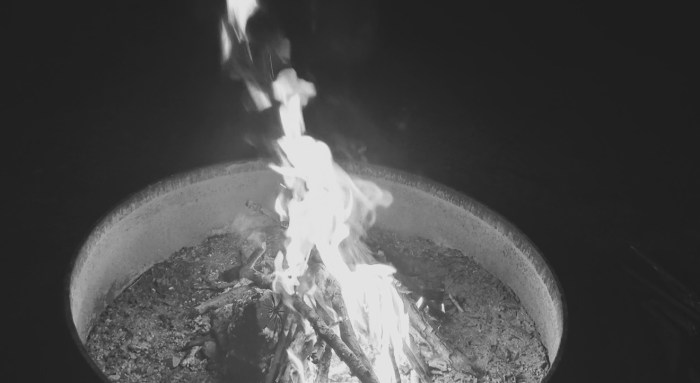
Later that afternoon, we sat beneath the pavilion with an early campfire going, trying to teach the dogs that sitting quietly outside can be an activity unto itself. They remain unconvinced.
We watched the flames and listened to the wood crackle while smoke inevitably found whichever direction one of us happened to be sitting. Move the chair, the wind changed. Move again, the smoke followed. There may be a metaphor in there somewhere, but we’re trying to give those a rest, too.
Instead, we decided we need a smokeless firepit.
We’ve been talking about one for quite a while, and camping has made the appeal more obvious. Their double-wall design draws in air and creates a secondary burn that consumes more of the smoke-producing particles before they escape, which means considerably less visible smoke once the fire is burning well. They also leaves less ash behind. The smaller models are portable enough to travel between home and a campsite, which suits us particularly well: we can use it on the bistro at home, then pack it up when we head out for the weekend.
Less smoke. Less shifting of chairs. Less trying to escape something that insists on following us around.
Maybe that part is a metaphor after all.
By evening, the larger conversation hadn’t produced a grand resolution for Thanksgiving. Cliff didn’t promised to remain silent. Jon didn’t suddenly become more tolerant. We’re still ourselves, after all.
But somewhere between walking the dogs around the loop and sitting together beside the fire, the question changed. It was no longer about what Cliff should or shouldn’t say to his sisters. It was about deciding how much of ourselves we want to give to arguments whose endings we already know.
Camping has become one of the places where we seem to understand these things a little better. There’s less noise out there, and after a while, fewer reasons to create our own. The dogs eventually settle. The fire burns down. The conversation wanders somewhere else. Darkness comes early this time of year, and before long we’re sitting together beneath the pavilion with nowhere we particularly need to be.
Some things can simply be left alone.


