The things that frighten us as children have a peculiar staying power. Monsters beneath the bed eventually reveal themselves as piles of clothes; the sinister shape outside the window becomes a tree moving in the wind. We’ve grown old enough to understand these things, but some part of us remembers what it was like when the distinction between imagined and real danger wasn’t so easily made.
We each brought some of those old demons with us when we found one another. Some have identifiable origins; others have been around so long that neither of us could say exactly where they came from. Over the years, we’ve become acquainted with each other’s ghosts as well as our own, learning the places where experience has left us wary and discovering that adulthood doesn’t necessarily make the monsters disappear. Mostly, it gives them more respectable names: uncertainty, disappointment, illness, loss, regret, the passage of time.
On Friday night, we talked about children, partly because our siblings have them and we don’t. For a while the conversation wandered into questions about what any of us ultimately leaves behind, but eventually we came around to something much simpler. Having children isn’t how we define a life, and neither is whatever might survive us when it’s over. What matters is the life in between: being good and decent people, caring for one another and those we encounter along the way, and leaving the place a little better than we found it.
By Saturday afternoon, after all that earnest consideration of what constitutes a life well lived, one of us was lying in a ditch.
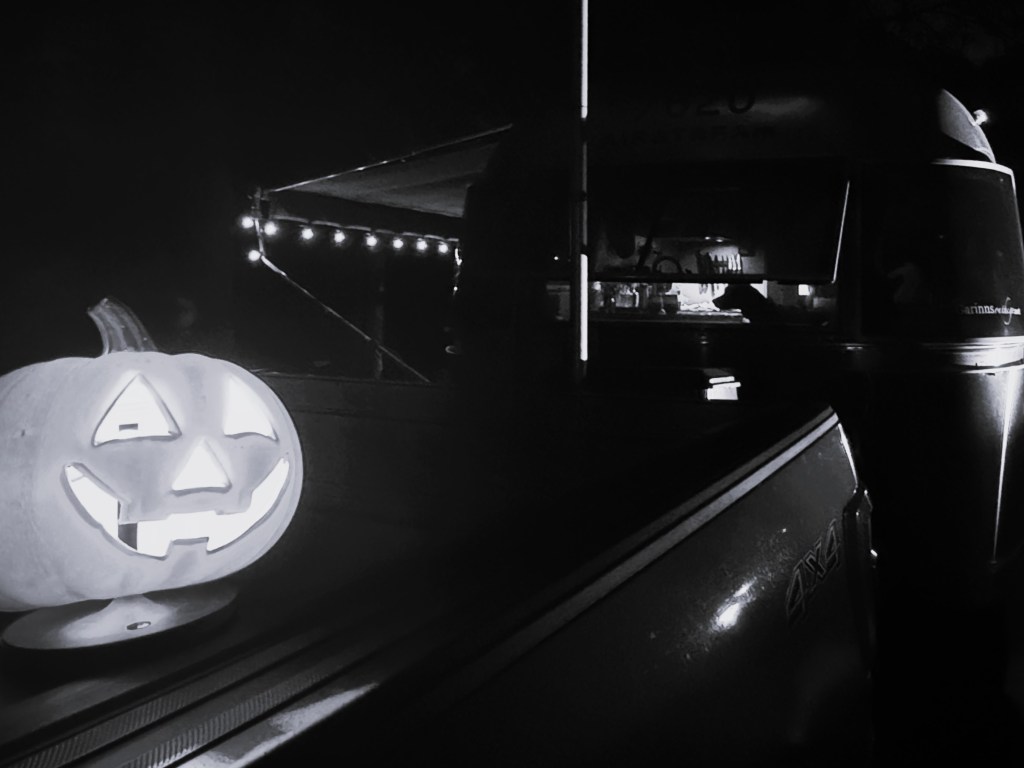
We were expecting trick-or-treaters at the campground, and Jon had set off on the electric scooter to retrieve some firewood and a bag of candy. The scooter tops out around 17 miles per hour, which is fast enough when you’re standing upright on two small wheels without attempting to transport what amounts to a small cord of wood. Doing it without a helmet only compounded the stupidity.
Overconfident? Yes. Stupid? Absolutely.
Somewhere along the way, scooter, firewood and rider parted company, and Jon landed in a ditch. Several members of a nearby wedding party came to his rescue. His eyeglasses were broken, one eye was swelling, and his ego had absorbed a fairly substantial blow of its own. One of those strangers drove him safely back to camp, where the sensible course of action for the remainder of the afternoon was to lie down and reconsider several recent decisions.
But the day wasn’t finished with us.
That evening, friends unexpectedly invited us to join them for a shrimp and crab boil. What had begun with an ill-advised expedition for firewood ended with good food, good friends, an electric scooter giveaway, and a campfire.
Only later did the contrast strike us. The night before, we had talked about what it means simply to lead good and decent lives. Less than a day later, several strangers saw someone who needed help and stopped. One made sure he got safely back to camp. Later, friends made room for us at their table. None of it was extraordinary, which may be precisely what made it matter.
Most of the ways we affect one another are probably like that. They happen quietly, without anyone thinking much about them. We show up. We help when we can. We make room at the table. A kindness offered to us becomes a reason to extend one to someone else. Whatever good passes between us eventually ceases to belong to any one person.
Perhaps that is why something Jon learned long ago in Scouting has become a principle we share: Leave the campsite better than you found it.
When we camp, one of the last things we do before leaving is walk the site again. We pick up what doesn’t belong there, including things left by people who came before us. We make sure the fire is out. We gather our things, take one last look around and drive away.
No one arriving after us will know about the conversations we had there, the friends who fed us, the strangers who stopped to help or the spectacularly poor decision involving firewood and electric transportation. They won’t know that, for a little while, this small patch of earth belonged to the two of us.
They don’t need to.
If we’ve done it right, they will simply find the place a little better than we found it.


